


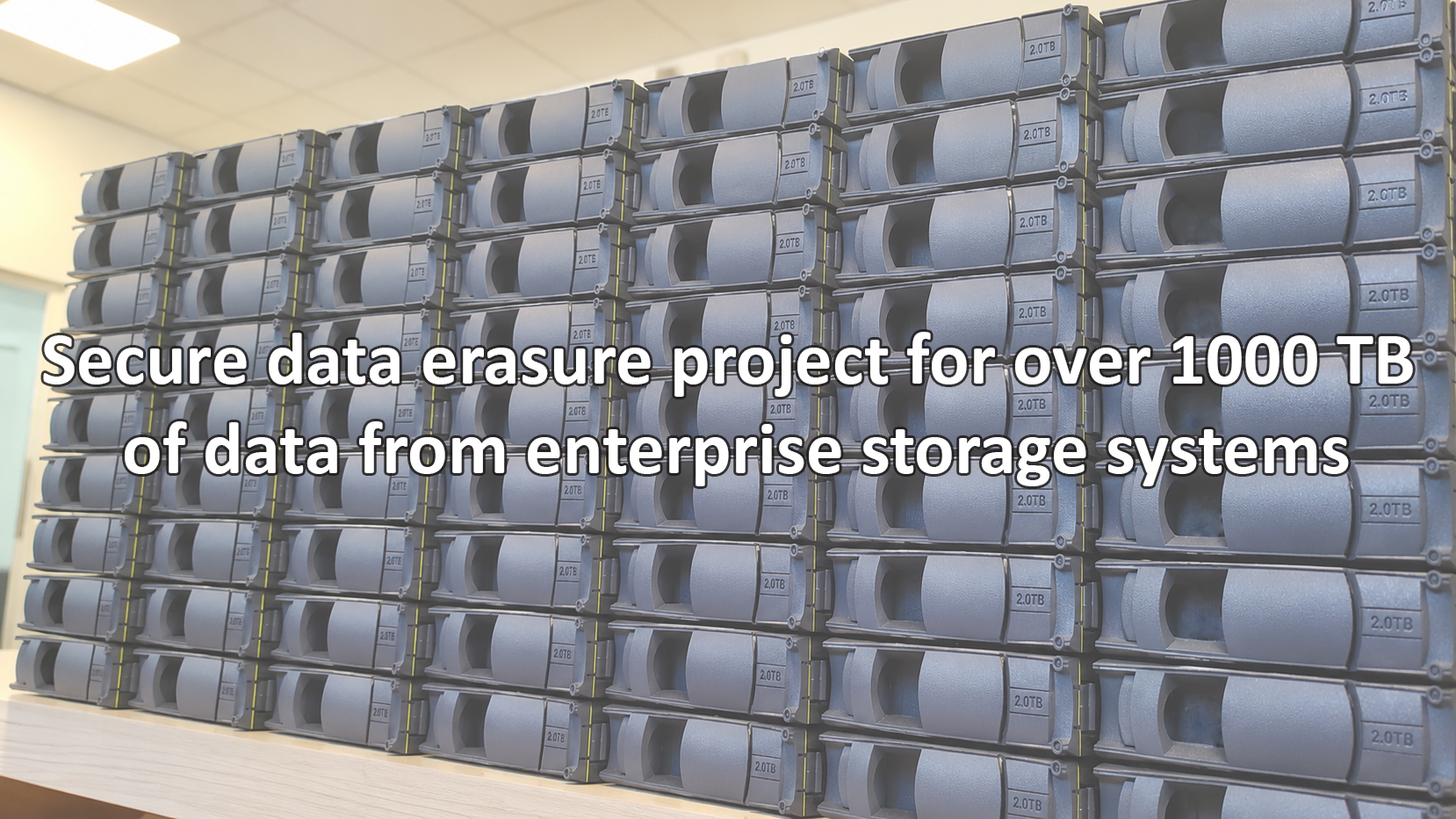
Hundreds of SAS drives with 520-byte sectors – secure data erasure project of over 1000 TB of enterprise storage systems
Recently, we completed a secure data erasure project involving several hundred enterprise SAS hard drives, with capacities ranging from 400 GB to 4 TB per drive. The total capacity of the processed devices exceeded 1,000 TB, or approximately one petabyte of data. For comparison, transferring such an amount of data over a 100 Mbps internet connection would take more than two and a half years of continuous operation.
Processing data at this scale represents a significant infrastructure challenge, especially when every device must be individually identified, processed, and verified. What makes this project particularly interesting is not only the number of drives and their combined capacity, but also the fact that the devices utilized 520-byte sectors, a format commonly found in enterprise environments where additional sector space is used for metadata and data integrity protection.
Difference Between 512-Byte and 520-Byte Sectors
Unlike standard 512-byte sectors used in desktop systems and most SATA drives, 520-byte sectors contain an additional 8 bytes per sector. These extra bytes are typically used for:
- T10 DIF/DIX data integrity protection
- End-to-end data validation
- Storage systemlevel error checking

(Visual comparison of 512-byte and 520-byte sectors)
Enterprise SAS drives formatted with 520-byte sectors are often not directly recognized by standard operating systems and controllers that expect sector sizes of 512 or 4096 bytes. For this reason, specialized SAS controllers and tools are frequently required to communicate with the drive in its original configuration. Otherwise, the device may appear as uninitialized or may not be detected by the system at all.
This means that standard data erasure tools often cannot directly access the entire addressable space without prior sector conversion or specialized hardware support.
Challenges of Secure Data Erasure
When dealing with hundreds of enterprise drives, the primary challenge is not the erasure itself, but rather the organization and control of the entire workflow. Every device must be properly identified, documented, included in the erasure procedure, and finally verified to confirm successful completion of the process.
Special attention was dedicated to tracking processing status, allocating hardware resources, and monitoring system performance throughout the multi-day operation. Simultaneously processing a large number of drives requires a stable environment to ensure reliable and consistent execution speeds.
Temperature management also played an important role. A large number of drives operating simultaneously under full workload generates a significant amount of heat, making proper cooling essential for maintaining system stability and predictable processing times.

(Enterprise SAS hard drives prepared for processing)
Approach and Methodology
After physical preparation, each drive was individually identified, included in the secure erasure procedure, and subsequently verified to confirm successful completion. This approach provided complete control over every device while minimizing the possibility of errors during large-scale processing.
A specialized version of the HddSurgery Wiper application was used for the project. The software was adapted for Linux environments utilizing SAS drives and controllers, ensuring full compatibility and successful processing of all devices involved.
Conclusion
Enterprise SAS environments utilizing 520-byte sectors require a significantly more precise and controlled approach than standard storage devices. Although they may appear to be ordinary hard drives at first glance, they are part of complex storage systems where every layer, from firmware to sector structure, can affect the secure data erasure process.
For projects of this scale, process reliability depends not only on the erasure software itself, but also on proper device tracking, result verification, and strict adherence to established procedures.
The project was successfully completed in accordance with the client’s requirements, including full validation of the erasure process and confirmation that all data had been securely and irreversibly removed. Throughout the project, a high level of control and reliability was maintained, enabling efficient execution of all activities and successful completion of the engagement.
HelpDisc, June 2026
SanDisk SSD PLUS 480 GB with firmware issue – HelpDisc data recovery
We received a 2.5’’ SATA SSD – SanDisk […]

When Refurbished Drives Fail: Inside an I.NORYS NAS HDD
We recently received a hard drive from a […]

A Case Study of Seagate ST16000NM001G Data Recovery
We had another Seagate helium-filled hard drive data […]

Helium hard drive data recovery is no laughing matter
Recently, a Seagate IronWolf Pro ST12000NE0008 12TB helium-filled […]

First in the world! Seagate Helium data recovery service
Dear clients,
On this occasion, we would like to […]

Do you need
data recovery?
Many years of experience in the field of data recovery and more than 11,000 satisfied clients guarantee the quality of our services. HelpDisc data engineers use modern software and tools that we have developed ourselves within the HDDSurgery brand. If you have a problem with lost data, write to us or fill out online request.